Doing Woke Right. Reflection for the 1st Sunday of Advent (Year A)
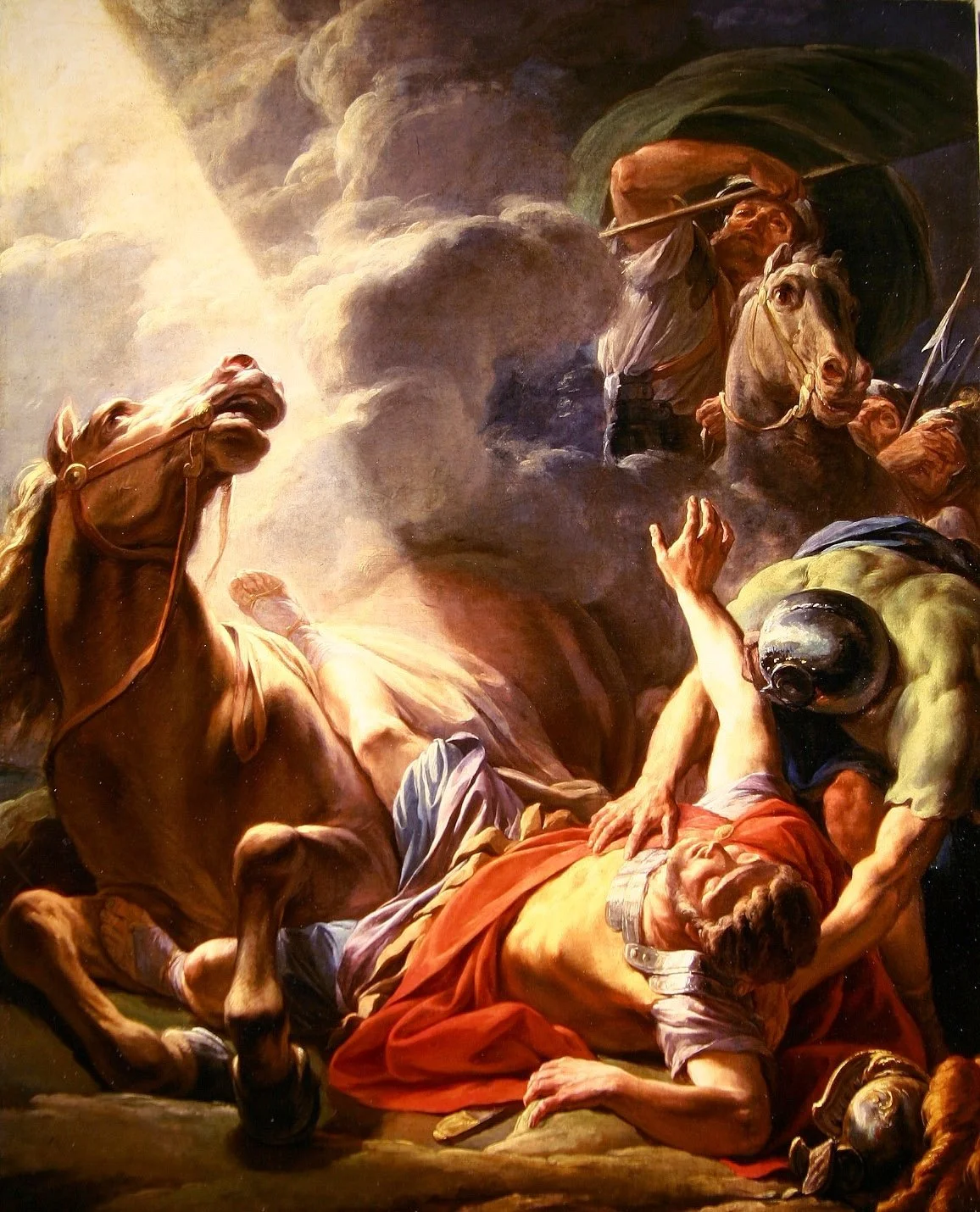
Painting: Conversion of St. Paul, Nicolas Bernard Lépicié, 1767
Woke.
Depending on who you say it to, this word evokes either disgust or approval.
One famous (American) man was not shy about his disdain.
He defines woke as follows
“You know what woke means right? It means you are a loser. Everything woke turns to sh*t.”
For this man, everything in his society has been going fairly well.
But due to “foreign” influence, people start to “awaken” to imagined problems.
And because of these fevered imaginations, everything is now taking a turn for the worse.
From a Catholic perspective, “woke” can be done wrong.
After all, it was the serpent who planted the idea that Adam and Eve were missing something.
“For God knows when you eat of this fruit, your eyes will be opened, and you will become like gods, knowing good and evil.” (Genesis 3:5)
When the “eyes of both of them were opened” (Genesis 3:7), i.e. when they “became woke”, all they discovered was their nakedness.
They have been scammed.
But woke can also be done right.
And the readings for the 1st Sunday of Advent point to why “being woke” is necessary and how to do it right.
In the first reading, the prophet Isaiah sketches a vivid vision of the temple of Jerusalem towering “above the mountains” and “lifted higher than the hills.” (Isaiah 2:2)
By virtue of their height, mountains are attention-grabbing.
“You can’t ignore me, I am tall.”
And they pique the curiosity of human beings.
“I wonder what is at the summit?” What view of the world is it offering should I reach the top?”
The temple of the Lord attracts even more attention.
“Pay attention. I am even taller than the tallest mountain.”
And sure enough, “all the nations will stream to it, people without number will come to it” (Isaiah 2:2)
The “view” that the temple of Jerusalem offers intrigues not only those in Judah and Jerusalem.
But people from all nations.
And what will they see should they reach the top?
People “hammering their swords into ploughshares, spears into sickles” (Isaiah 2:4)
Nations no longer lifting the sword against another nation.
“There will be no more training for war.” (Isaiah 2:4)
It is a vision of perpetual peace.
War and conflict are abnormal.
But because we are at the foot of the mountain, we normalise the abnormal.
We often do it through slogans.
“If you value peace prepare for war.”
“Peace through strength.”
In a fallen world, perhaps these slogans are sad necessities.
But they are not in themselves normal.
They are normal reactions to an abnormal situation.
We need to be “woke.”
To be awakened to another view.
And the “light of the Lord” (Isaiah 2:5) helps us to see that.
For the peace of Jerusalem pray: “Peace be to your homes! May peace reign in your walls, in your palaces peace!” (Psalm 122:7)
This should be normal. Do not settle for anything less. Strive with the Lord’s help to make this a lived reality.

In the second reading, St. Paul tells the Romans to “wake up now”. Stop doing things that they “prefer to do under cover of the dark” (Romans 13:12)
He pulls no punches and names specific behaviours. “No drunken orgies, no promiscuity or licentiousness, no wrangling or jealousy.” (Romans 13:13)
In modern parlance, “No netflix and chill. No clicking on those videos. And certainly no anonymous trolling,” behaviours which are often done in the wee hours of the night.
Instead, “let us arm ourselves and appear in the light. Let us live decently as people do in the daytime.” (Romans 13:12)
Paul had painted a picture of a dramatically fallen world in his opening chapter of his letter to the Romans.
And towards the tail end of his epistle, he diagnoses one important reason.
The indulgence in so-called “private” vices.
For St. Paul, these behaviours may be personal, but they are never private.
Accumulated, they darken the mind, “claiming to be wise they became fools.” (Romans 1:22)
Being “woke” for Paul is to recognise its spiritual danger. And to take action by “letting your armour be the Lord Jesus Christ.” (Romans 13:14)
In the Gospel, the connection between the geopolitical disaster of war and the indulgence in vice is vividly illustrated with Jesus’ description of the flood that swept people away during the days of Noah.
“For in those days before the Flood, people were eating, drinking, taking wives, taking husbands, right up to the day Noah went into the ark, and they suspected nothing till the Flood came and swept all away.” (Matthew 24:38-39)
If you are only familiar with this description of Noah’s ark by Jesus, you would think that the disaster was sudden, without warning.
But if you are familiar with the story of Noah’s ark in the book of Genesis (as Jesus’ original Jewish audience was), you would detect the irony in what Jesus just said.
In the book of Genesis, Noah was 500 years old when he started building the ark.
When the flood finally came, he was 600 years old.
People had 100 years to realise that something was amiss.
But they were asleep. Because “every inclination of the thoughts of the human heart was only evil all the time. (Genesis 6:5). And the “earth was corrupt in God’s sight, full of violence” (Genesis 6:11).
Private vices. Public violence.
It lulled them into a false sense of security. That’s just the way the world is. It’s just the normal cycle of life.
Hence, “they suspected nothing. Until the flood came and swept them away.” (Matthew 24:39)
This Advent, the Church urges her children to “do woke right.”
Be awakened to the connection between public disasters and private vice.
Do not settle for partial solutions.
Instead, do woke right, by resolving to give our hearts to Jesus so that he might transform them into hearts of flesh.
“Stay awake, because you do not know the day when your master is coming” (Matthew 24:42).
And when he comes, we can run forth to meet him with righteous deeds at his coming.