Already But Not Yet.
Reflection for the 3rd Sunday of Advent Year A
Come Lord and save us. – Psalm 146
John the Baptist is in jail.
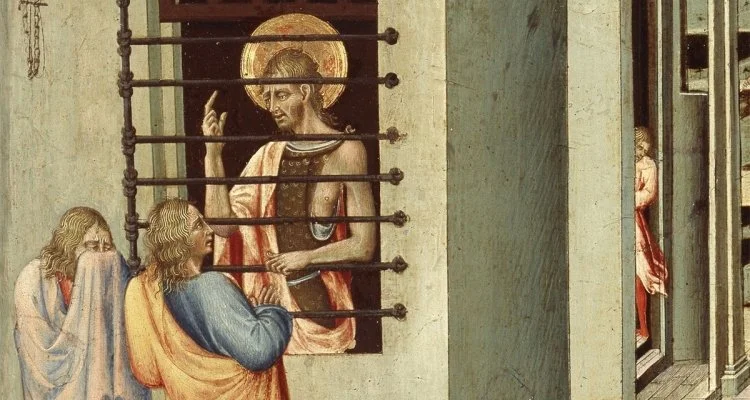
He had denounced the tetrarch of Galilee, Herod Antipas for marrying his brother Philip’s wife.
And was arrested for his troubles.
The followers of John were undeterred. John had said that “he must decrease and Jesus’ increase.” (John 3:30)
And so, they turned to Jesus.
They are familiar with Isaiah’s prophecy which we read in the first reading. “Look, your God is coming, vengeance is coming, the retribution of God; he is coming to save you.”(Isaiah 35:4)
And John had said that Jesus can “baptise with Holy Spirit and fire (Matthew 3:11)
But Jesus does not lead a people’s march to the Marchereus fortress to demand John’s release.
He holds off the brimstone and fire and continues his ministry of preaching and healing.
As if John’s arrest had not occurred.
Anguished, it is very likely that his followers visited John and poured out their sorrows at the fact that their beloved master is still in jail.
Where is the vengeance? Where is the retribution? Where is the salvation?
John, recognising his followers’ anguish, puts it to Jesus in words which his followers may not have dared to ask,
“Are you the one who is to come, or have we got to wait for someone else?” – Matthew 11:3
It was an honest question, borne out of incomprehension.
And perhaps it is also our question.
Today is Gaudete (Rejoice) Sunday.
What exactly are we called to rejoice in if we can’t rejoice in seeing those who do evil being overthrown and getting their just deserts?
And if the Messiah does not do this, should we also have to wait for someone else?
Jesus does not answer the question with a simple yes or no.
Instead, he paraphrases the first reading from Isaiah 35.
But in the PRESENT tense.
“The blind see, the lame walk, lepers are cleansed, the deaf hear and the dead are raised to life.”
The signs associated with the coming Messiah are being fulfilled.
How about vengeance and retribution?
That would eventually come, but not yet.
Or in the words of Jesus, “happy is the man who does not lose faith in me.”
Therein lies, I think, the challenge of Gaudete Sunday for Christians.
To live in the space of the already and not yet.
And find reasons not to lose faith in Jesus.
We experience clear signs of God’s work in our lives.
But we simultaneously experience the reality that God has not yet delivered on all his promises.
God wants us to wait. Or in the words of the second reading
“Be patient, brothers. Think of a farmer, how patiently he waits for the precious fruit of the ground until it has had the autumn rains and the spring rains. You too have to be patient; do not lose heart, because the Lord’s coming will be soon” (James 5:7-8)
In this passage, James uses the analogy of the farmer who was able to practice patience because he knew that two cycles of rain were necessary for his land to produce its fruit.
If he begins harvesting too early, he will ruin his produce.
Could it also be that for certain things in our lives, an early attempt to “harvest” will also ruin our produce?
Perhaps we have experienced a grave injustice at the workplace.
We want that to be rectified the soonest.
And our desire for that to be rectified is indeed just.
Yet perhaps, God, in the time of our waiting, wants first to heal us of our own blindness, when we fail to see how we may have contributed to the situation.
Or to heal us of our refusal to really listen, when others were trying to communicate their thoughts to us.
And finally, to heal us of our limiting beliefs and sins that cripple us. So that we can not only walk, but run and not go weary, with God being our strength. (Isaiah 40:31)
When we work on our own healing, we may be in a better position to ensure that the justice, which will eventually come, will bear a good harvest.
In his book Jesus of Nazareth, Pope Benedict XVI points to the deepest reason why a Christian can rejoice in the Lord always (Philippians 4:4).
Many ask “What did Jesus actually bring, if not world peace, universal prosperity, and a better world? What has he brought?”
And the Pope answers:
“He has brought God, and now we know his face, now we can call upon him.” “Now we know the path that we human beings have to take in this world. Jesus has brought God, and with God the truth about our origin and destiny: faith, hope and love. It is only because of our hardness of heart that we think this is too little.”[1]
Indeed the Lord is near. (Philippians 4:5) May everlasting joy reflect on our faces (Isaiah 35:10) as we behold the face of God.