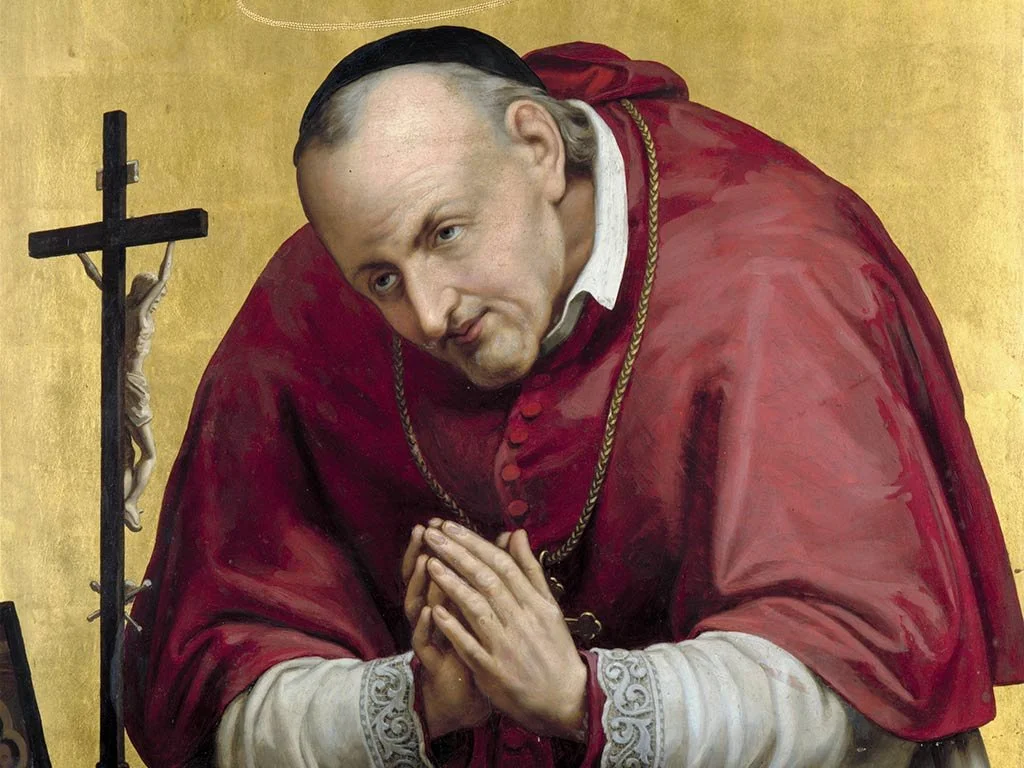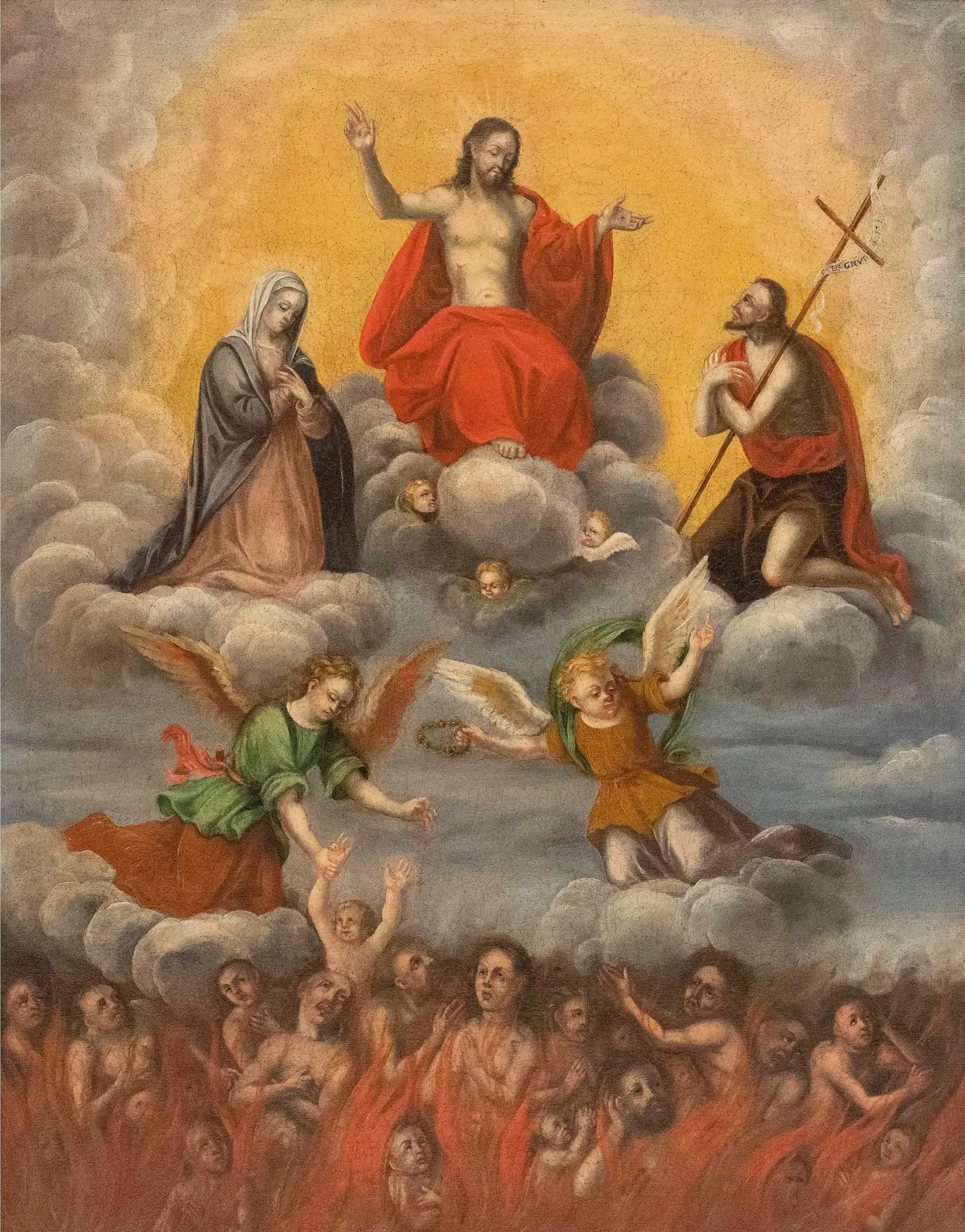
Painting: Andachtsbild Jüngstes Gericht, circa 1674, Wikimedia
Here let me make a digression in favour of those holy souls. If we desire the aid of their prayers, it is but fair that we should mind to aid them with our prayers and good works. I said it is fair, but I should have said it is a Christian duty; for charity obliges us to succour our neighbour when he requires our aid, and we can help him without grievous inconvenience. Now it is certain that amongst our neighbours are to be reckoned the souls in purgatory, who, although no longer living in this world, yet have not left the communion of saints. The souls of the pious dead,' says St. Augustine, are not separated from the Church,' and St. Thomas says more to our purpose, that the charity which is due to the dead who died in the grace of God is only an extension of the same charity which we owe to our neighbour while living: Charity, which is the bond which unites the members of the Church, extends not only to the living, but also to the dead who die in charity.' Therefore, we ought to succour, according to our ability, those holy souls as our neighbours; and as their necessities are greater than those of our other neighbours, our duty to succour them seems also to be greater.
But now, what are the necessities of those holy prisoners? It is certain that their pains are immense. The fire that tortures them, says St. Augustine, is more excruciating than any pain that man can endure in this life: That fire will be more painful than anything that man can suffer in this life.' St. Thomas thinks the same, and supposes it to be identical with the fire of hell: The damned are tormented and the elect purified in the same fire.' And this only relates to the pains of sense. But the pain of loss (that is, the privation of the sight of God), which those holy souls suffer, is much greater; because not only their natural affection, but also the supernatural love of God, wherewith they burn, draws them with such violence to be united with their Sovereign Good, that when they see the barrier which their sins have put in the way, they feel a pain so acute, that if they were capable of death, they could not live a moment. So that, as St. Chrysostom says, this pain of the deprivation of God tortures them incomparably more than the pain of sense: The flames of a thousand hells together could not inflict such torments as the pain of loss by itself.' So that those holy souls would rather suffer every other possible torture than be deprived for a single instant of the union with God for which they long. So St. Thomas says that the pain of purgatory exceeds anything that can be endured in this life: The pain of purgatory must exceed all pain of this life.' And Dionysius the Carthusian relates, that a dead person, who had been raised to life by the intercession of St. Jerome, told St. Cyril of Jerusalem that all the torments of this earth are refreshing and delightful when compared with the very least pain of purgatory: If all the torments of the world were compared with the least that can be had in purgatory they would appear comfortable.' And he adds, that if a man had once tried those torments, he would rather suffer all the earthly sorrows that man can endure till the Day of Judgment, than suffer for one day the least pain of purgatory. Hence St. Cyril wrote to St. Augustine: That as far as regards the infliction of suffering, these pains are the same as those of hell'their only difference being that they are not eternal.' Hence we see that the pains of these holy souls are excessive, while, on the other hand, they cannot help themselves; because as Job says: They are in chains and are bound with the cords of poverty (Job 36, 8). They are destined to reign with Christ; but they are withheld from taking possession of their kingdom till the time of their purgation is accomplished. And they cannot help themselves ( at least not sufficiently, even according to those theologians who assert that they can by their prayers gain some relief,) to throw off their chains, until they have entirely satisfied the justice of God. This is precisely what a Cistercian monk said to the sacristan of his monastery: Help me, I beseech you, with your prayers; for of myself I can obtain nothing.' And this is consistent with the saying of St. Bonaventure: Destitution prevents solvency.' That is, those souls are so poor, that they have no means of making satisfaction.
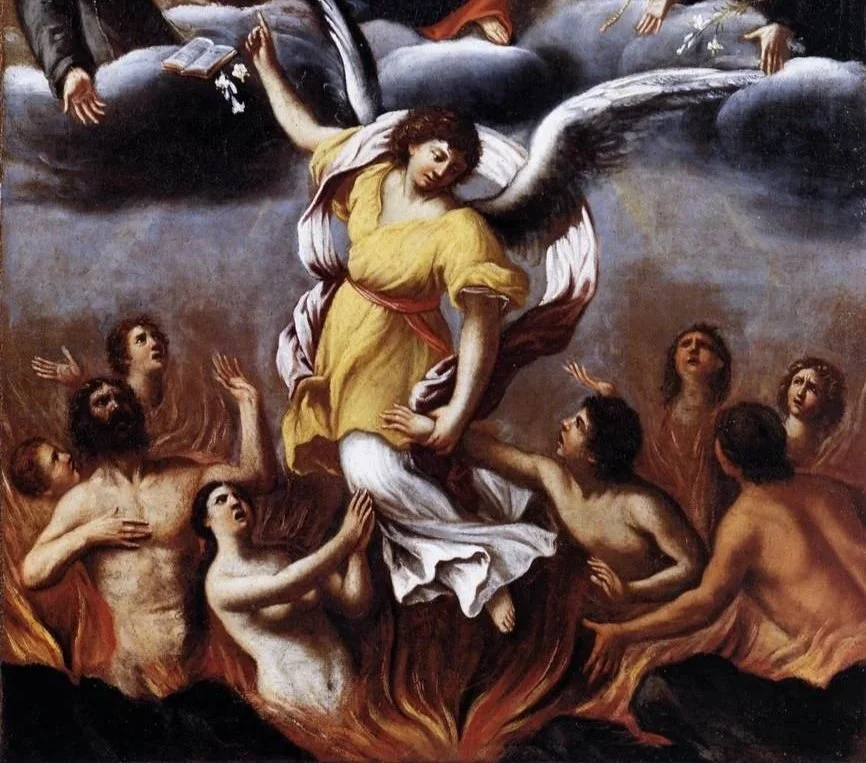
Painting: Ludovico Carracci: English: An Angel Frees the Souls of Purgatory, 1610
On the other hand, since it is certain, and even of faith, that by our suffrages, and chiefly by our prayers, as particularly recommended and practiced by the Church, we can relieve those holy souls, I do not know how to excuse that man from sin who neglects to give them some assistance, at least by his prayers. If a sense of duty will not persuade us to succour them, let us think of the pleasure it will give Jesus Christ to see us endeavouring to deliver his beloved spouses from prison, in order that he may have them with him in paradise. Let us think of the store of merit which we can lay up by practicing this great act of charity; let us think, too, that those souls are not ungrateful, and will never forget the great benefit we do them in relieving them of their pains, and in obtaining for them, by our prayers, anticipation of their entrance into glory; so that when they are there they will never neglect to pray for us. And if God promises mercy to him who practices mercy towards his neighbour'Blessed are the merciful for they shall obtain mercy (Mt. 5, 7) 'he may reasonably expect to be saved who remembers to assist those souls so afflicted, and yet so dear to God. Jonathan, after having saved the Hebrews from ruin by a victory over their enemies, was condemned to death by his father Saul for having tasted some honey against his express commands; but the people came before the king, and said, Shall Jonathan then die, who hath wrought this great salvation in Israel? (I Samuel 14,45). So may we expect that if any of us ever obtains, by his prayers, the liberation of a soul from purgatory, that soul will say to God: Lord, suffer not him who has delivered me from my torments to be lost.' And if Saul spared Jonathan's life at the request of his people, God will not refuse the salvation of a Christian to the prayers of a soul which is his own spouse. Moreover, St. Augustine says that God will cause those who in this life have most succoured those holy souls, when they come to purgatory themselves, to be most succoured by others. l may here observe that, in practice, one of the best suffrages is to hear Mass for them, and during the Holy Sacrifice to recommend them to God by the merits and passion of Jesus Christ.
The following form may be used: Eternal Father, I offer you this Sacrifice of the body and blood of Jesus Christ, with all the pains which he suffered in his life and death; and by his passion I recommend to you the souls in purgatory, and especially that of . . . etc. And it is a very charitable act to recommend, at the same time, the souls of all those who are at the point of death.