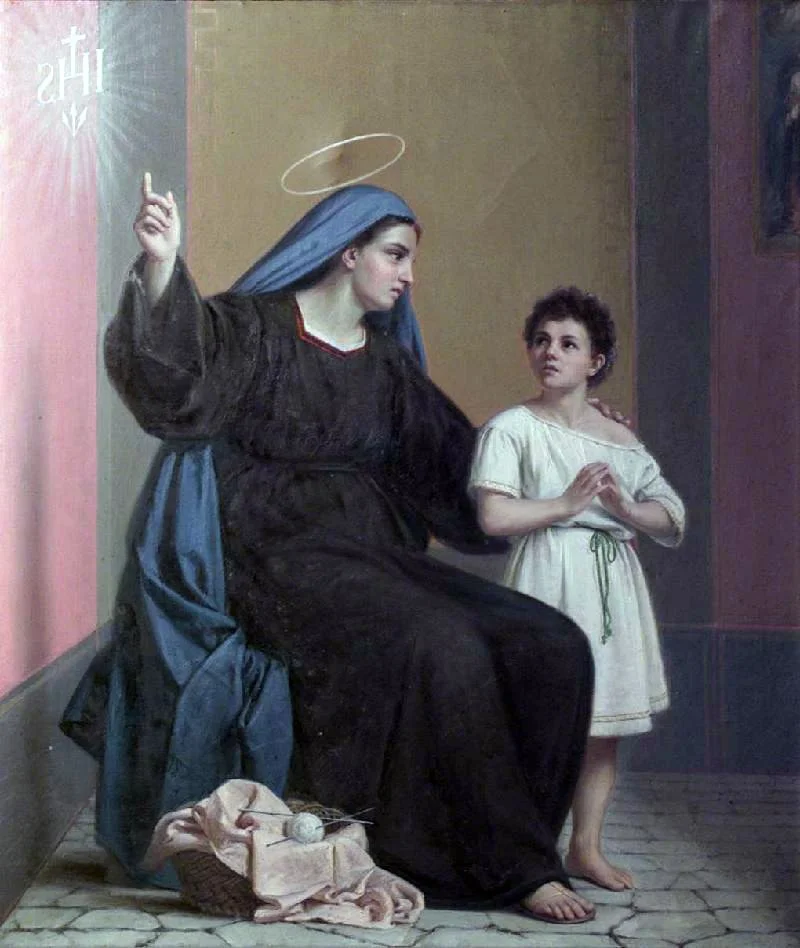
St. Monica’s Conversation With Her Son, St. Augustine
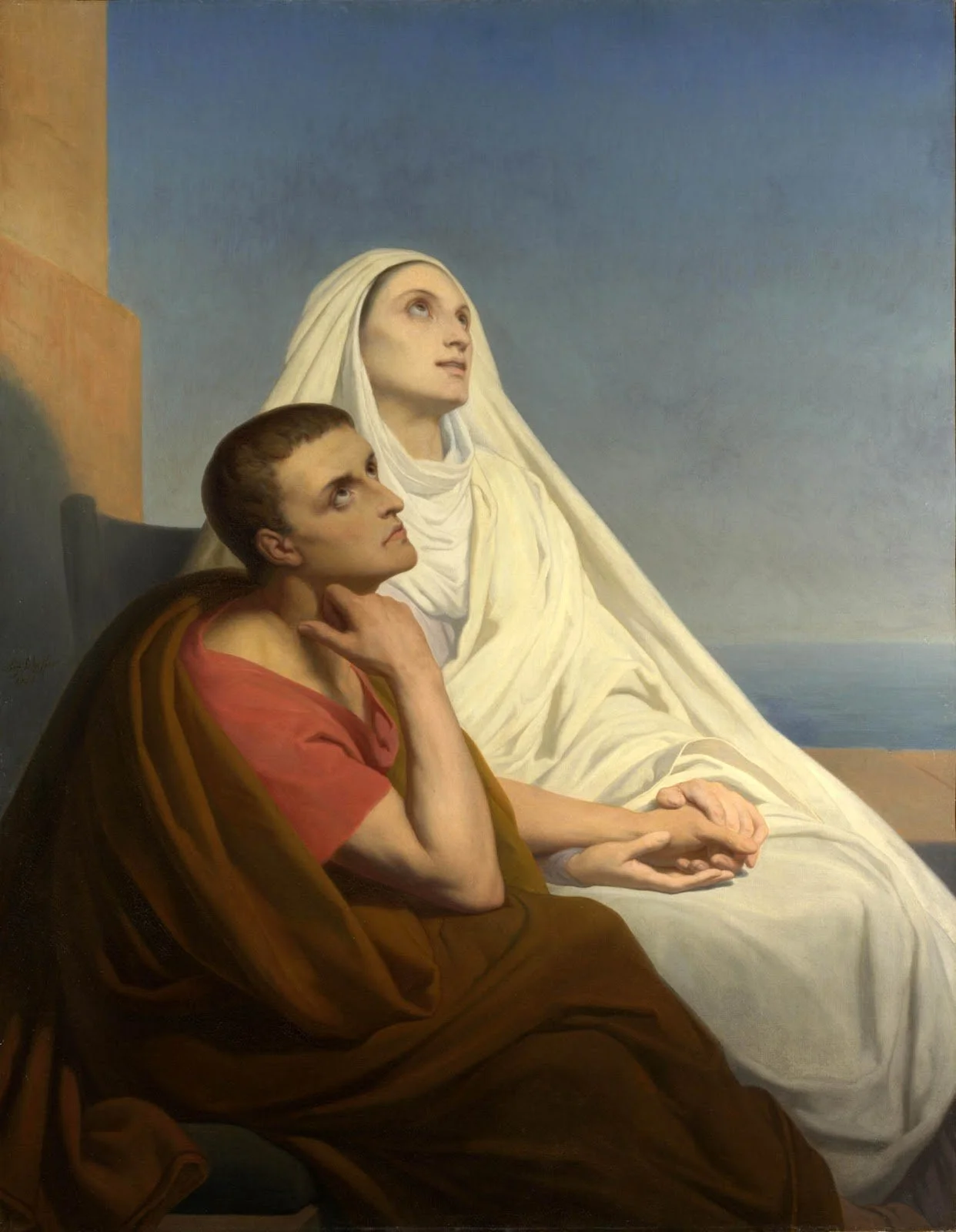
Painting: Saints Augustine and Monica by Ary Scheffer, 1854
Chapter 10. A Conversation He Had with His Mother Concerning the Kingdom of Heaven.
23. As the day now approached on which she was to depart this life (which day Thou knew, we did not), it fell out — Thou, as I believe, by Your secret ways arranging it — that she and I stood alone, leaning in a certain window, from which the garden of the house we occupied at Ostia could be seen; at which place, removed from the crowd, we were resting ourselves for the voyage, after the fatigues of a long journey. We then were conversing alone very pleasantly; and, “forgetting those things which are behind, and reaching forth unto those things which are before,” Philippians 3:13 we were seeking between ourselves in the presence of the Truth, which You are, of what nature the eternal life of the saints would be, which eye has not seen, nor ear heard, neither has entered into the heart of man. But yet we opened wide the mouth of our heart, after those supernal streams of Your fountain, the “fountain of life,” which is “with You;” that being sprinkled with it according to our capacity, we might in some measure weigh so high a mystery.
24. And when our conversation had arrived at that point, that the very highest pleasure of the carnal senses, and that in the very brightest material light, seemed by reason of the sweetness of that life not only not worthy of comparison, but not even of mention, we, lifting ourselves with a more ardent affection towards “the Selfsame,” did gradually pass through all corporeal things, and even the heaven itself, whence sun, and moon, and stars shine upon the earth; yea, we soared higher yet by inward musing, and discoursing, and admiring Your works; and we came to our own minds, and went beyond them, that we might advance as high as that region of unfailing plenty, where You feed Israel for ever with the food of truth, and where life is that Wisdom by whom all these things are made, both which have been, and which are to come; and she is not made, but is as she has been, and so shall ever be; yea, rather, to have been, and to be hereafter, are not in her, but only “to be,” seeing she is eternal, for to “have been” and “to be hereafter” are not eternal. And while we were thus speaking, and straining after her, we slightly touched her with the whole effort of our heart; and we sighed, and there left bound “the first-fruits of the Spirit;” Romans 8:23 and returned to the noise of our own mouth, where the word uttered has both beginning and end. And what is like Your Word, our Lord, who remains in Himself without becoming old, and “makes all things new?” Wisdom 7:27
25. We were saying, then, If to any man the tumult of the flesh were silenced — silenced the phantasies of earth, waters, and air — silenced, too, the poles; yea, the very soul be silenced to herself, and go beyond herself by not thinking of herself — silenced fancies and imaginary revelations, every tongue, and every sign, and whatsoever exists by passing away, since, if any could hearken, all these say, “We created not ourselves, but were created by Him who abides for ever:” If, having uttered this, they now should be silenced, having only quickened our ears to Him who created them, and He alone speak not by them, but by Himself, that we may hear His word, not by fleshly tongue, nor angelic voice, nor sound of thunder, nor the obscurity of a similitude, but might hear Him — Him whom in these we love— without these, like as we two now strained ourselves, and with rapid thought touched on that Eternal Wisdom which remains over all. If this could be sustained, and other visions of a far different kind be withdrawn, and this one ravish, and absorb, and envelope its beholder amid these inward joys, so that his life might be eternally like that one moment of knowledge which we now sighed after, were not this “Enter into the joy of Your Lord?” Matthew 25:21 And when shall that be? When we shall all rise again; but all shall not be changed.
26. Such things was I saying; and if not after this manner, and in these words, yet, Lord, You know, that in that day when we were talking thus, this world with all its delights grew contemptible to us, even while we spoke. Then said my mother,
“Son, for myself, I have no longer any pleasure in anything in this life. What I want here further, and why I am here, I know not, now that my hopes in this world are satisfied. There was indeed one thing for which I wished to tarry a little in this life, and that was that I might see you a Catholic Christian before I died. My God has exceeded this abundantly, so that I see you despising all earthly felicity, made His servant — what do I here?”