Dads for Life. Challenge and Consolation from the Feast of the Holy Family
Reflection for the Feast of the Holy Family year A
O blessed are those who fear the Lord and walk in his ways. – Psalm 127:1
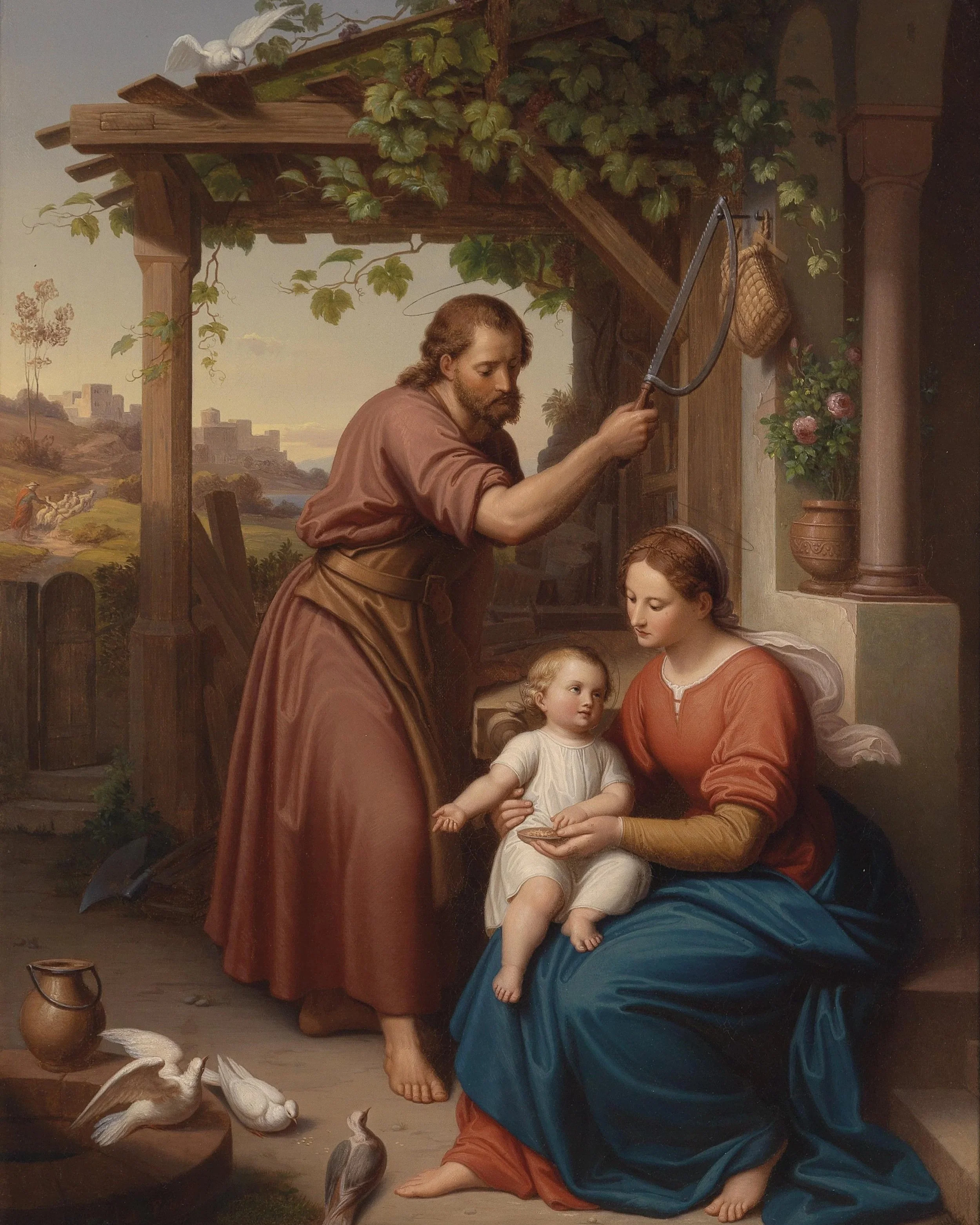
Jesus, Mary and Saint Joseph by Julius Frank
Dads for Life.
If you are a Singaporean, you might recognise this as a national fathering movement. With a fascinatingly familiar vision "to turn the hearts of the fathers to their children".
In an article interviewing founder Mr Jason Wong, it notes that too often, “hearts of fathers had been turned away (absent) or turned against (abusive) their children, resulting in curses on the land.”[1]
Dads for Life hopes to change that.
When I reflected on this movement’s goals, I was struck by its very title:
A Dad's impact on their children is indeed for life, for good or for ill.
As Saint John Paul II teaches,
“In revealing and in reliving on earth the very fatherhood of God, a man is called upon to ensure the harmonious and united development of all the members of the family.”[2]
And the readings for the Feast of the Holy Family provide a comprehensive map and compass for the church to build a culture of fatherhood by comforting and challenging fathers.
And also, by exhorting others to be cheerleaders.
The first reading from the book of Sirach opens with the following exhortation:
“Whoever respects his father is atoning for his sins.” (Sirach 3:3)
To sin against someone, is to damage a previously harmonious relationship.
To atone, as the word suggests, is to make a relationship “one” again.
Every Christian recognises the need for ongoing conversion. To make right your relationships between God, your family and your neighbours.
And one concrete way to know that you are striving to do so, is to honour your father.
So far so good. Hebrew advice which resonates with Asian notions of filial piety.
However, when I read this verse again this time, something struck me.
Could the verses also be talking about how honouring your father can also atone for his sins?
After all, the subsequent verses from Sirach paint a picture of fathers who fall short:
“Even if his mind should fail, show him sympathy,
do not despise him in your health and strength;
for kindness to a father shall not be forgotten
but will serve as reparation for your sins.” (Sirach 3:13-14)
In the translation used by the Jerusalem Bible, it suggests that due to old age, fathers may suffer from increasingly poor judgment.
The Revised Standard Version translates as follows: “Even if he is lacking in understanding, show forbearance”.
Fathers do not always have it all together. And the scriptures acknowledge this reality squarely.
Jacob, for instance, practised favouritism, causing his elder brothers to hate their younger brother Joseph. And indirectly caused Joseph to be sold into Egypt by his brothers.
Joseph eventually rises to the rank of governor general of Egypt. He was in a position to get his revenge when his family went to Egypt to beg for grain due to a famine. He refuses. And instead extends a hand of forgiveness, redeeming the effects of his father’s poor choices.
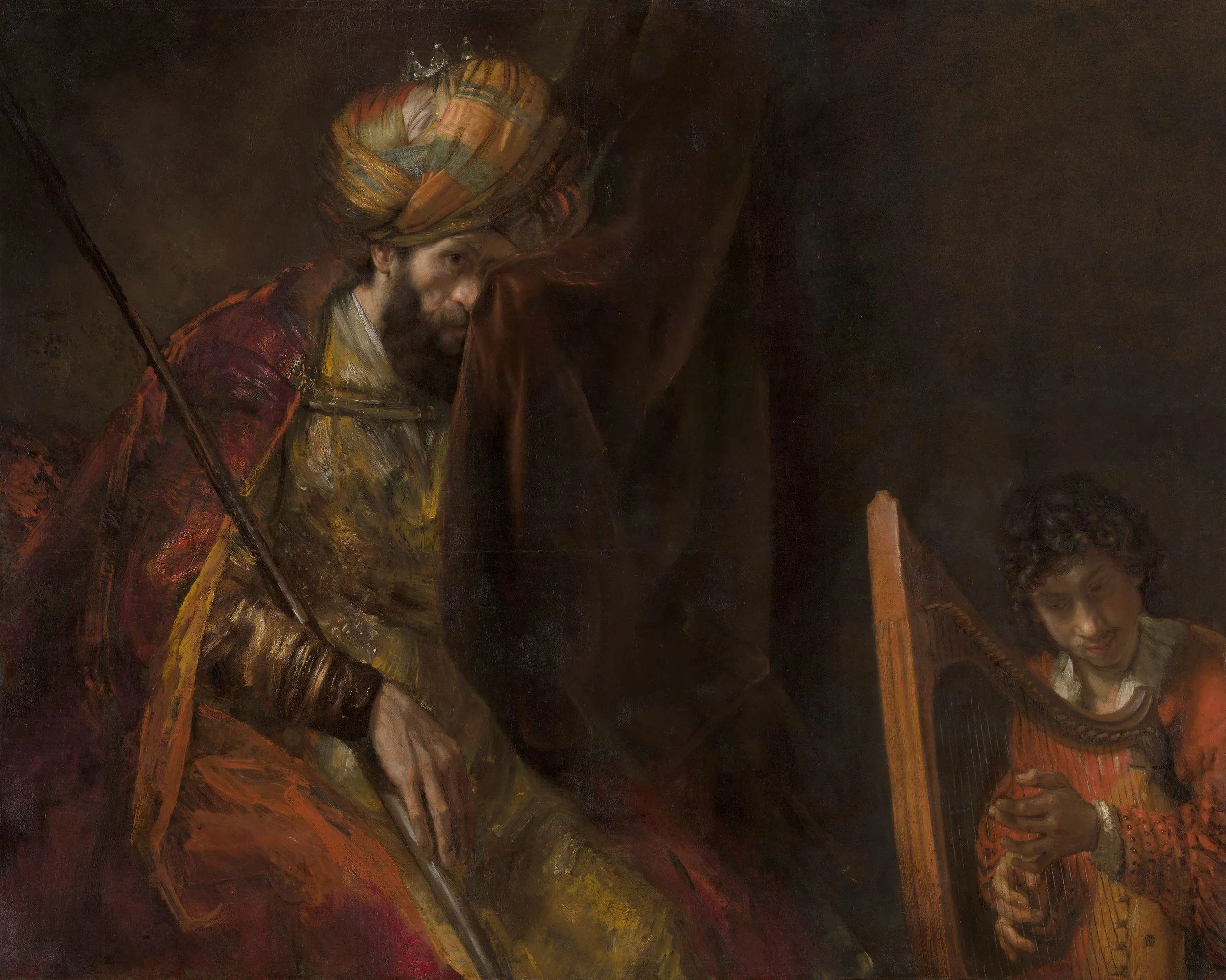
Saul and David by Rembrandt, 1651 to 1658
King Saul was David’s Father-in-law. Unfortunately, out of paranoia and jealousy, he started to persecute David and accused him of attempting to usurp the throne. David had to protect himself and flee. However, when given an opportunity to kill Saul, he refused, saying that he will not harm the Lord’s anointed. He even reminded Saul that he could have done so, causing Saul to search his conscience. David did not trust Saul’s overtures of reconciliation, preferring to keep a distance. However, his show of mercy to his Father-in-law was genuine.
These two examples illustrate what the book of Sirach might have in mind about flawed Fathers and the ongoing duties of children. They provide important case studies for discernment, especially in the light of what many observers have termed a sharp spike in children deciding that “no contact” with their parents is the correct response for their parent’s failures.
The book of Sirach comforts flawed Dads. And challenges children to continue honouring their parents.
The second reading from the letter to the Colossians challenges the entire family to remember their identity in Christ: “You are God’s chosen race, his saints; he loves you”. After recognising who you are, it goes on to list out virtues which all family members should cultivate, to be “clothed in sincere compassion, kindness, humility, gentleness and patience” To measure progress, Paul invites family members to ‘bear with one another, forgive each other as soon as a quarrel begins,’ demonstrating his pastoral realism.
After discussing the foundational virtues, Paul goes on to discuss the distinctive activities of the Christian family. That they are to internalise the message of Christ: “let the message of Christ in all its richness, find a home in you.” They are to talk to each other about the faith explicitly, “teach each other and advise each other in all wisdom.” Finally, they are to pray together “with gratitude in your heart,s sing psalms and hymns and inspired songs to God.”
It is only after an extended discussion on virtues and Christian practices that Paul goes on to discuss how authority and responsibility is to be exercised among wives, husbands and children. In Roman society in the first century, women and children would be more vulnerable compared to men. Wives are to give way to husbands, but “in the Lord”, that is within the horizon of Christ’s self-giving love and not arbitrary domination. Children are to be obedient to your parents, because it would please the Lord. The stronger party, ie husbands, are to love their wives and treat them with gentleness. And both set of parents are reminded to never drive children to resentment.
A number of things emerge from the letter to the Colossians.
Firstly, a careful reading of the entire text rules out any attempt to co-opt it in a power struggle. Parents should not smile at their children for instance when the text calling for obedience to parents is read. And subsequently ask their children to “be quiet” at mass, when they counter it by drawing attention to the text telling parents not to drive children to resentment.
Instead, the text should be understood as a vision and mission statement for the entire family so that they can realise their identity as saints and mediate the love of Christ to each other.
Finally, the Gospel focuses on a Father figure once more, namely the person of Joseph, and highlights one very distinct task, to be the protector of his family, exercising authority not through force, but through obedience, courage, and self-sacrifice.
Two recurring motifs can be observed in this account:
That the angel of the Lord appeared to him in a dream and warned him of grave danger.
That without hesitation, he got up and took “the child and his mother with him” to safety.
Pope Francis teaches that:
In the Bible, dreams were considered a means by which God revealed himself. The dream symbolises the spiritual life of each of us, that inner space that each of us is called to cultivate and guard, where God manifests Himself and often speaks to us.[3]
To be a protector, Joseph had cultivated a deep interior life and was sensitive to the promptings of God. Upon discerning God’s voice, Joseph was decisive and acted. It has also to be said that Mary submitted wholeheartedly to Joseph’s directions. This time, the angel of the Lord appeared to Joseph, the head of the family. The trust between the holy couple was mutual and there was no hint of question or doubt.
Joseph thus becomes a model for fathers: to cultivate a deep prayer life, so that this interior foundation can sustain their vocation as protectors of the family.
The responsorial psalm paints a picture of a happy family that seeks the Lord always:
“Your wife will be like a fruitful vine
in the heart of your house;
your children like shoots of the olive,
around your table.” (Psalm 127:3)
And indeed, putting the teaching of the readings today will surely contribute to the happiness and holiness of family life. Yet it would be remiss to end without noting that scripture itself recognises that those who seek the Lord, who desire for instance to be protectors may often fall short, through no fault of their own.
The Gospel reading omits the verses of the slaughter of the Holy Innocents by King Herod.
Among those families who lost their children to the command of an evil king, must surely be fathers who desperately tried to protect their beloved child, only for their lives to be ruthlessly snuffed out.
The tragic dimension of family life often leaves us speechless and sorrowful. It is in these times that the example of the Holy Family becomes an even more important source of hope.
The perfect family was not spared the experience of tragedy. One may even argue that their mission of redemption would inevitably draw them into the shadow of tragedy. May we also draw strength from their example so that we can be challenged and consoled in our own family lives.