Sinner, Servant and Son
(Reflection for the Feast of the Baptism of the Lord year A)
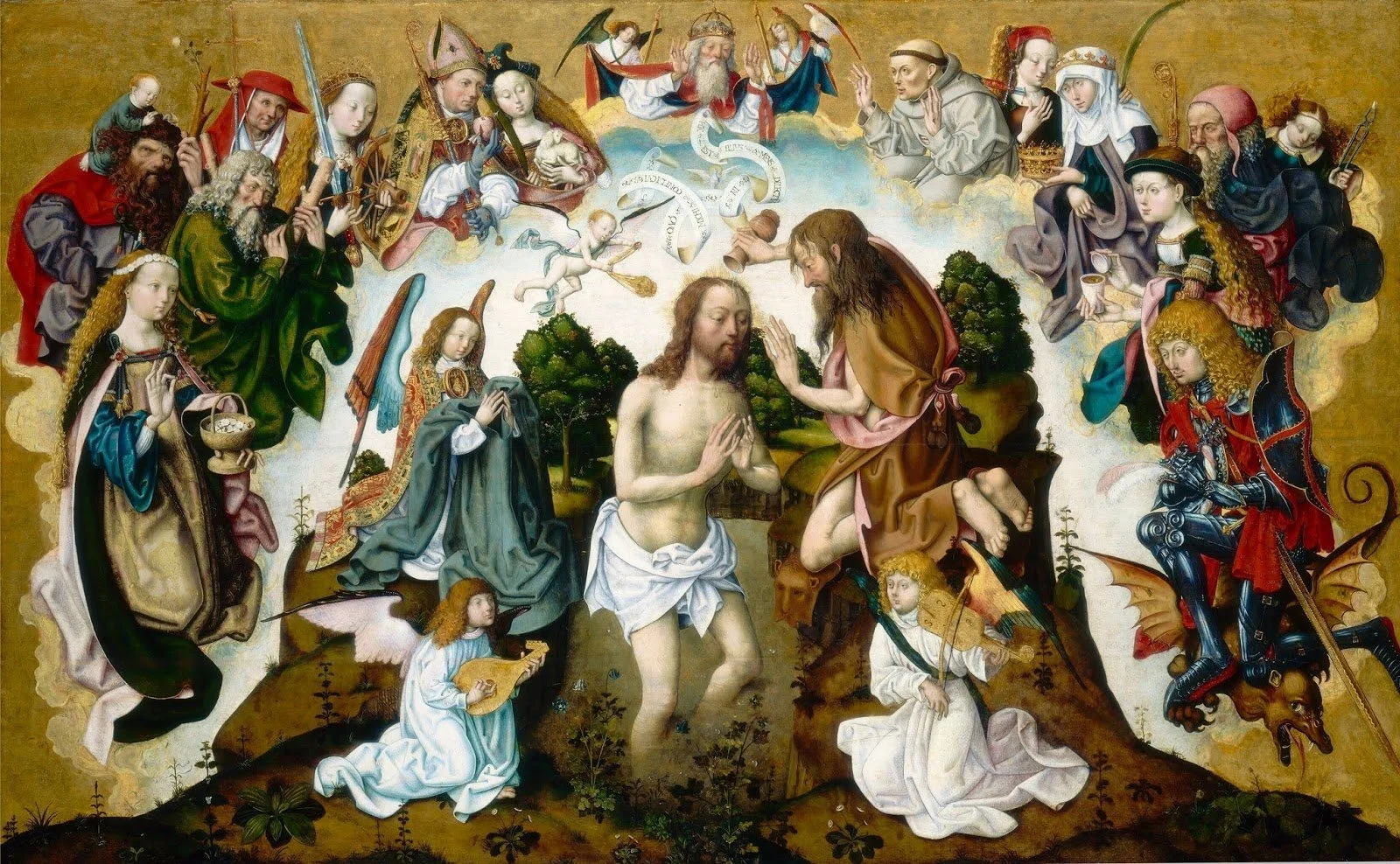
Master of St. Bartholomew Altar. Baptism of the Lord. Oil on panel, circa 1485-1500.
I have endowed him with my spirit that he may bring true justice to the nations. – Isaiah 42:1
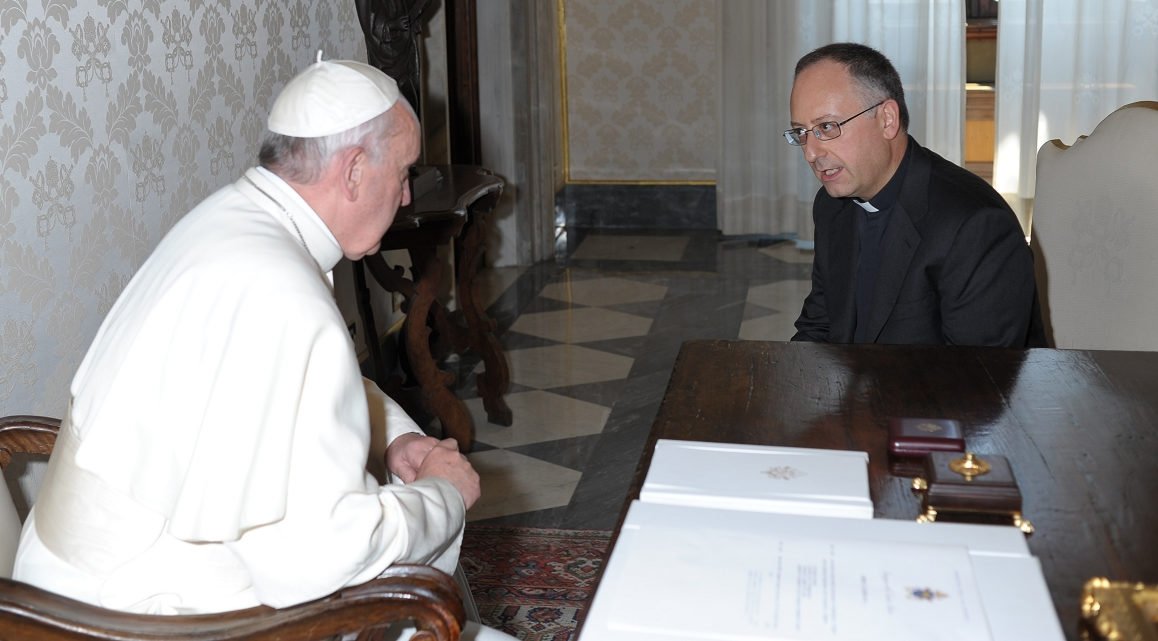
In his first major interview around 5 months into his papacy, Pope Francis was asked:
“Who is Jorge Mario Bergoglio?”
The question was not about Francis the Pope, but Jorge the person.
Father Antonio Spadaro, who asked the question, describes the Pontiff’s reaction and his reply:
The pope stares at me in silence. I ask him if this is a question that I am allowed to ask.... He nods that it is, and he tells me: “I do not know what might be the most fitting description.... I am a sinner. This is the most accurate definition. It is not a figure of speech, a literary genre. I am a sinner.” [1]
It is not often that a world leader starts a first major interview confessing not simply that in his lifetime, he has made mistakes or could have done things differently.
Rather, this world leader confesses that in a very radical sense, he is a failure.
Father Spadaro goes on to share the Pope’s subsequent elaboration:
“…the best summary, the one that comes more from the inside and I feel most true is this: I am a sinner whom the Lord has looked upon.” And he repeats: “I am one who is looked upon by the Lord. I always felt my motto, Miserando atque Eligendo [By Having Mercy and by Choosing Him], was very true for me.” [2]
I am a failure, and yet the Lord does not look away. Rather, the Lord, knowing that I am a failure, looks upon me, not with condemnation, contempt, or condescension but with mercy. And because he has looked first upon me with mercy, I respond by choosing him.
I am a sinner, yet the Lord looks upon me with mercy. He does not simply forgive. He has used for me. And even beyond that, he has called me to an unimaginable inheritance, to be his adopted sibling.
Sinner, Servant, Son.
That is the unifying theme of the readings for the baptism of the Lord.
Sinner
In the Gospel reading, John the Baptist expressed his astonishment that Jesus came to him for Baptism.
“It is I who need baptism from you’ he said, ‘and yet you come to me!’ (Matthew 3:14)
John the Baptist has been preaching repentance to the people of Israel, as the most adequate preparation for the coming of the Messiah. Baptism, the “drowning” of the old self in water and “rebirth’ as the sinner reemerges from the depths, was the symbolic action. It was needed for everyone in Israel- except the Messiah.
But Jesus shows up.

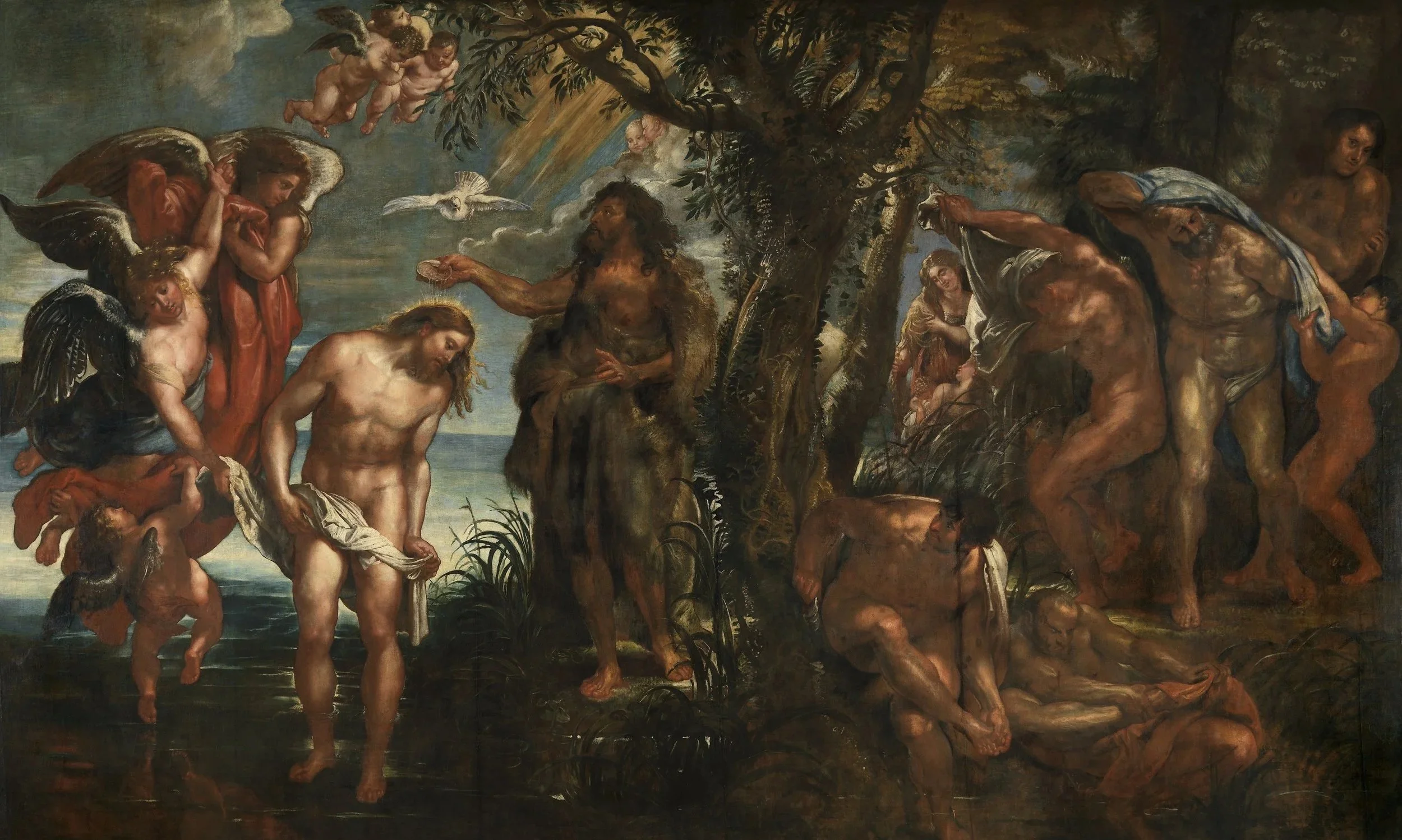
Painting: Juan Fernández de Navarrete - Baptism of Christ, circa 1568
He is the savior, and not the one who needed saving.
And yet here he was. He explains to John what his intentions were,
“Leave it like this for the time being; it is fitting that we should, in this way, do all that righteousness demands.” (Matthew 3:15)
Jesus affirms John’s fundamental instinct. He is not coming to John as a sinner to seek repentance. Rather, he is coming as a Savior who considers it fitting to plunge into the same pool as sinners, to save them.
If we imagine salvation in practical terms, Jesus behaves like a lifeguard with a very unusual rescue strategy.
Indeed, if you are trained as a lifeguard, you might pause at this time and scratch your head at the “life-saving techniques” employed by Jesus.
The first rule of being a lifeguard is always to be as far as possible “rescue on land”. If someone is drowning in the swimming pool, a lifeguard should first try to catch the person’s attention and then toss him a lifebuoy attached to a rope. He can then reel him in.
Immediately jumping into the water without a prior assessment, far from a fitting response, would be considered reckless.
The principles of lifeguarding dictate that the lifeguard should only do so as a last resort, as his own safety and that of the victim might be jeopardized.
But Jesus is the lifeguard who plunges straight into the water.
Because the victim he is trying to save — humanity — is not only drowning, but often in denial, distracted, or resigned to the water.
They are unaware of the danger or even dismissive and in denial of their precarious position.
Some of them know that they are drowning and in despair. They do not care anymore.
He could still shout from land.
But by drawing close and being in the water himself, he shows what kind of lifeguard he is.
Someone willing to risk drowning himself, or in his own words, “do all righteousness demands” in order to save a victim.
In the invitatory psalm prayed at Lauds, the exhortation “Oh that today you would listen to his voice! Harden not your hearts!” is prayed every day, reminding the Christian that God, the lifeguard, wants to save those who are drowning. Hence, “listen to his voice”.
But we are a special breed of sinner. Often in the habit of denying that we need saving or questioning the credentials of the lifeguard.
Or even, in the words so hauntingly sung in the Good Friday liturgy, more than willing to “prepare a cross for your savior.”
Hence, we need to pray always not to “harden our hearts.”
Servant
“The Lord will bless his people with peace.” The verse echoes again and again after each stanza.
Peace is the gift of the “lifeguard” Jesus Christ.
Yet peace is also a task. Having been rescued in the waters of baptism, the baptised Christian now shares in the mission of the Saviour.
The words of the prophet Isaiah, applied to the Messiah, apply also in an analogous fashion to those whom the Messiah saves.
“I, the Lord, have called you to serve the cause of right; I have taken you by the hand and formed you” (Isaiah 42:6)
The mission of the baptized is not small. It is to bring true justice to the nations.
To open the eyes of the blind.
To free captives from prison.
To lead those who live in darkness out of the dungeon.
To labor until true justice is established on earth.
As the baptized share in his mission, they also simultaneously share in the delight the Heavenly Father has for the Messiah,
“Here is my servant whom I uphold, my chosen one in whom my soul delights.” (Isaiah 42:1)
Many religions exhort their followers to obey the Creator as a matter of justice. Some religions go further by reminding their followers that it is a delightful duty. The Hebrew bible, through the Prophet Isaiah, goes even further with an earth-shattering proclamation.
The Creator delights in his creature personally.
Son
As if that is not earth-shattering enough, the New Testament dares to say something even more intimate,
“And a voice spoke from heaven, ‘This is my Son, the Beloved; my favour rests on him.” (Matthew 3:17)
In the context of Jesus’ baptism, the voice from heaven was primarily the Father’s personal endorsement of Jesus’ mission. It was also a simultaneous declaration from heaven of Jesus’ identity. It would have caused a stir among the crowd who would have heard this voice. It served to open the hearts of those who witnessed this miracle to the message that Jesus would proclaim.
Yet through his preaching, Jesus opens another dimension of discipleship, summed up in the astonishment in the letter of St John, which the lectionary has been reading from post-Christmas.
“How great is the love the Father has lavished on us, that we should be called children of God! And that is what we are! (1 John 3)
The apostle John was a young man when he first followed Jesus. He was an eyewitness at his baptism. This truth had never failed to astonish him.
St Jerome shares an anecdote of Saint John, in his old age,
The blessed John the Evangelist lived in Ephesus until extreme old age. His disciples could barely carry him to church and he could not muster the voice to speak many words. During individual gatherings he usually said nothing but, “Little children, love one another.” The disciples and brothers in attendance, annoyed because they always heard the same words, finally said, “Teacher, why do you always say this?” He replied with a line worthy of John: “Because it is the Lord’s commandment and if it alone is kept, it is sufficient.” He said this because of the Apostle’s present mandate: “Let us do good to all people, especially to those who belong to the household of faith.” [3]
The baptism of the Lord concludes the season of Christmastide and begins the season of Ordinary Time, for the Church’s liturgical calendar. As we move into a new season, the knowledge that we are simultaneously sinners, servants, and sons are the three foundation stones on which the Christian life is built as the year progresses.
Indeed, as the second reading reminds Christians, all human beings are called to the same inheritance and mission. “God does not have favorites, but that anybody of any nationality who fears God and does what is right is acceptable to him.” (Acts 10:34)
“Jesus went about doing good and curing all who had fallen into the power of the devil.’ (Acts 10:38)
We do the same, in our own concrete circumstances, as Ordinary Time dawns on us.