
Why We Must Become Saints
Ever since my confirmation in the Church in 2023, I have always loved the Solemnity of All Saints. There is something so wondrous about celebrating a magnificent army of Holy men, women, and children who have gone before the present generation to be united to God. In fact, the saints are probably my favourite part of the Church. I may struggle with praying my daily rosary or doing other devotional acts like reading Scripture and the Catechism of the Catholic Church, but I never tire of reading the lives of the saints.
Perhaps part of my fascination with studying and celebrating a multitude of holy people arises from the common observation that such holiness is usually scarce in the people around us, even in the Church. People are often unforgiving, quick to take offense, and carry a few other defects, like being ungrateful for the good done by others. I am no exception, and I accept that part of the reason why the people around me are not saints is due to my sinfulness. This brings me to the main point of this essay, about why we must strive for sainthood for the good of the Church. I argue that the chief reason to strive after holiness is simply because it usually encourages others to do the same, that saints encourage sanctity.
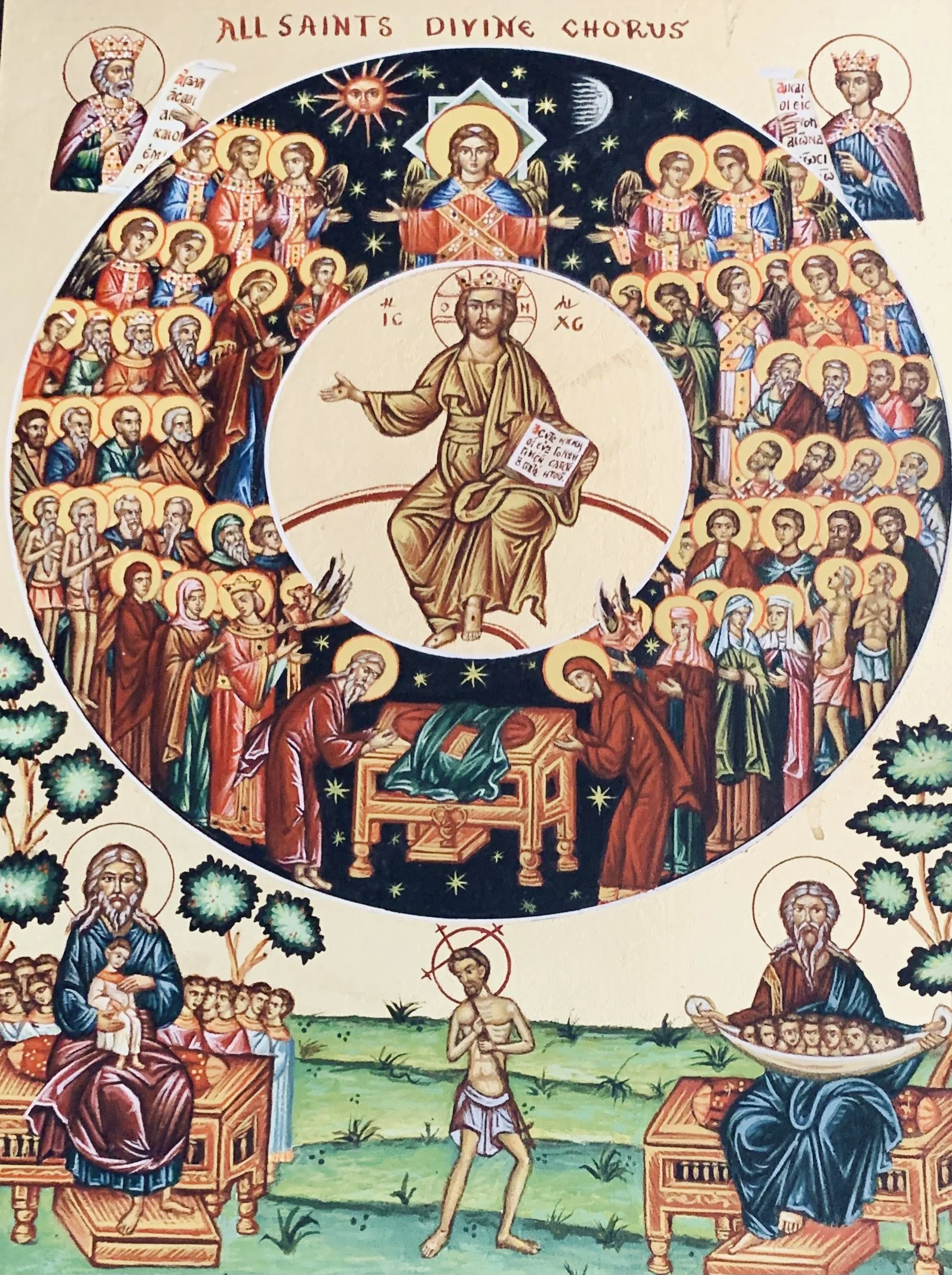
'I tell you, many will come from east and west and will eat with Abraham and Isaac and Jacob in the kingdom of heaven, ' (Matthew 8:11) (All-saints Byzantine Catholic Church nd).
Every day, I get the feed of the saints that are venerated on each day of the liturgical calendar on a Facebook channel called HagiograFaith (HagiograFaith nd). Reading this feed for about two years now has informed me of the richness of holiness in the Church. It has also informed me of the patterns of holiness too - where sainthood arises, what choices do saints make that normal Catholics do not, and how saints interact with the world around them.
One of the main things that strikes me is the fact that many saints know each other.
There are different ways in which saints know each other.
The first is by direct contact, when saints directly interact with each other.
This is very common. Many know that St Therese’s parents, Louis Martin and Azelie Guerin, are saints too, but how many perhaps would know that St Basil the Great’s family is filled with saints? St Basil the Great’s parents are saints (Sts Basil the Elder and Emilia), his older and younger sisters are saints (Sts Macrina the Younger and Theosebia) and so are three of his younger brothers (Sts Peter of Sebaste, Naucratius and Gregory of Nyssa) (Meg 2025).
Saints also know each other by contact as friends. One famous saintly friendship was that of St Basil the Great and St Gregory Nazianzen, where the latter proclaimed that they were two bodies in one spirit (Gregory 2023). Perhaps the greatest group of saintly friends that I can think of would be what I call the Spanish school of Reformation saints, that powerful group of holy reformers in the 16th century.
Let us start by discussing St John of Avila, the renowned preacher and reformer of the Spanish faithful. His sermons inflamed the heart of St John of God, the founder of the Brothers Hospitallers of St John of God, a group of lay religious brothers dedicated to serving the sick in hospitals (Knight nd). These sermons also touched the lives of St Francis Borgia, St Peter of Alcantara and St Teresa of Jesus just to name a few saintly examples. Borgia went on to become the third superior general of the Jesuits, Peter the reformer of the Discalced Franciscans, and Teresa the reformer of the female Carmelites Discalced (Neuburger 2024). St Teresa was also influenced by St Peter too, with his encouragement being the reason why she embarked on the Carmelite reform (Knight nd).
The second way in which saints know each other is by reading up on their lives.
This method ensures that the holiness of past saints is replicated or even exceeded by present ones. The most famous example is that of St Ignatius of Loyola reading up on the lives of the saints and being inspired to become one during his time of recovery in Pamplona (Knight nd). In fact, he was encouraged to surpass his saintly predecessors in penance shortly after his conversion (Knight nd).
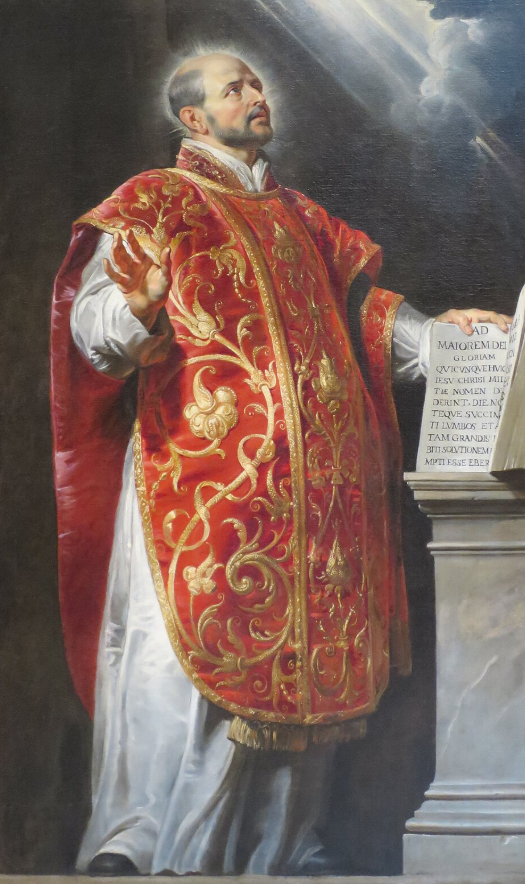
“What St. Francis and St. Dominic have done, that, by God's grace, I will do” – St Ignatius of Loyola after his conversion in Pamplona (Wikipedia 2025).
The third and final way is through miraculous visions.
Through the lives of the saints, we know that certain saints were very devoted to other saintly companions who have gone before them. Sometimes, the living saints learn more about holiness through the direct miraculous appearances of those who have gone before them. One night, when St John Chrysostom was praying deeply for his commentary on an epistle of St Paul to be effective in instructing the faithful on God, the Apostle himself whispered without a sound to the mind of the Patriarch (iconandlight 2013). When Chrysostom’s attendant reached the door of the saint to contact him on some matter, he gazed through the keyhole to see a man resembling the icon of St Paul whispering to the saint (iconandlight 2013). It turns out that God sent the Apostle himself to instruct the one who will instruct the faithful on the ways of truth (iconandlight 2013). In her effort to unite herself totally to God through the Dominican vocation, St Catherine of Siena was privileged to receive visions of the Lord, the Blessed Virgin Mary, St John the Evangelist, St Paul, St Dominic and even King David (Raymond 2011, pg 81). In fact, Catherine can be said to have received the vocation directly from the father of the Dominicans directly by receiving the habit of the Third Order from him in a dream (Raymond 2011, pg 31).

Icon of St John Chrysostom receiving instruction from St Paul (Facebook 2025).
We notice a similarity in all these ways in which the saints interact with other saints. They all result in the spreading of holiness from one to the other. It can be said that the saints do not simply inspire virtue but rather excite it.
The saints are the flint that God uses to strike sparks into the tinder that is the Church militant, with the resulting blaze being the souls that are inflamed by the fire of the Holy Spirit.
To use a simile, it is almost as if God is a sailor throwing life buoys connected by chains towards the people thrown overboard. The ship is heaven, where true peace lies, and the rough waters are the various passions that assail a person and cause them to lose balance in the ship and fall into the sea of sin. The links of the chain are the saints that God uses to save His people, the elect. For while He desires to save all overboard individuals, only those who look upon the ship and desire it will seek the life buoys. There are different saints that are particularly drawn to each elect, and God pulls on these chains to draw the elect towards Him.
The saints are, therefore, by the great number of examples shown in the preceding paragraphs, the instruments by which God uses to save others. This should not be surprising since the saints have most perfectly aligned their wills to God’s by His grace, and so whatever they ask in His name will be granted, including the salvation of more souls (John 14:12-14).
Apart from interceding for the salvation of souls, the saints also help to save others by their holy example. As established in the introduction, virtue is usually less common than sin in the world around us. The Catechism goes further to highlight how sin has flooded the world after the fall of Adam and Eve (CCC 401). Therefore, one’s encounter with a saint in any form would encourage a change in behaviour, as the various examples show.
"Modern man listens more willingly to witnesses than to teachers, and if he does listen to teachers, it is because they are witnesses." (Paul VI 1975, para 41)
To end, it must be acknowledged that holiness is never a personal venture but one that involves others too. By attaining holiness, a saint is very likely to influence those around them to become saints too. Christians are called to be the light of the world, where our illumination brings others to recognise the goodness of God and give glory to Him (Matthew 5:14-16).
“'Therefore, since we are surrounded by so great a cloud of witnesses, let us also lay aside every weight and the sin that clings so closely, and let us run with perseverance the race that is set before us, looking to Jesus the pioneer and perfecter of our faith, who for the sake of the joy that was set before him endured the cross, disregarding its shame, and has taken his seat at the right hand of the throne of God.” (Hebrews 12:1-2).
Bibliography:
HagiograFaith. “Hagiografaith.” Facebook. Accessed November 9, 2025. https://www.facebook.com/hagiografaith.
Meg Hunter-Kilmer. “A Family and Their Friends with at Least a Dozen Saints.” Aleteia, January 2, 2025. https://aleteia.org/2017/05/25/meet-the-family-and-their-friends-that-gave-the-church-at-least-a-dozen-saints/.
Nazianzen, St Gregory. “Sts Basil and Gregory, Two Bodies One Spirit - Gregory Nazianzen.” Crossroads Initiative, December 31, 2023. https://www.crossroadsinitiative.com/media/articles/sts-basil-and-gregory-two-bodies-one-spirit/.
All-saints Byzantine Catholic Church. “Iconography at All Saints.” All Saints, The Spiritual Home for All of Southwest Florida since 1981. Accessed November 20, 2025. https://www.allsaintsbyzantine.com/iconography-at-all-saints.
Knight, Kevin. “St. John of God.” CATHOLIC ENCYCLOPEDIA: St. John of God. Accessed November 20, 2025. https://www.newadvent.org/cathen/08472c.htm.
Neuburger, Sr. Clotilde. “St. John of Avila – He Enraptured Multitudes.” Heralds of the Gospel Magazine, May 13, 2024. https://catholicmagazine.news/st-john-of-avila-he-enraptured-multitudes/.
Knight, Kevin. “St. Peter of Alcántara.” CATHOLIC ENCYCLOPEDIA: St. Peter of Alcantara. Accessed November 20, 2025. https://www.newadvent.org/cathen/11770c.htm.
Knight , Kevin. “St. Ignatius Loyola.” CATHOLIC ENCYCLOPEDIA: St. Ignatius Loyola. Accessed November 20, 2025. https://www.newadvent.org/cathen/07639c.htm.
Wikipedia. “Ignatius of Loyola.” Wikipedia, November 7, 2025. https://en.wikipedia.org/wiki/Ignatius_of_Loyola.
Iconandlight. “St. Paul Inspiring and Guiding St. John Chrysostom.” iconandlight, April 5, 2025. https://iconandlight.wordpress.com/2013/11/13/st-paul-inspiring-and-guiding-st-john-chrysostom/.
Capua, Blessed Raymond of. The Life of St. Catherine of Siena. Charlotte, NC: TAN Books, 2011.
Church. Catechism of the Catholic Church Ascension Edition. West Chester, PA: Ascension Publishing Group, 2022.
Paul VI, Pope. “Evangelii Nuntiandi (December 8, 1975).” Vatican. Accessed November 24, 2025. https://www.vatican.va/content/paul-vi/en/apost_exhortations/documents/hf_p-vi_exh_19751208_evangelii-nuntiandi.html.
“Log into Facebook.” Facebook, June 14, 2025. https://www.facebook.com/photo?fbid=1134659132035526&set=a.556336903201088.
