Unlikely place, Unlikely people, Unforgettable compassion
(Reflection for the 3rd Sunday of Ordinary Time year A)

Christ Preaching (The Hundred Guilder Print), by Rembrandt (1606–1669)
We try to be polite, but we often can’t help it.
We respond differently to different places and people.
If you say you are living in Orchard Road, people will likely go “oh wow!”
If you say you are living in Yishun it’s likely “oh” (followed by giggles)
If someone introduces himself as a lawyer, instant respect.
If an undertaker, instant awkwardness.
It’s the same for the people of Jesus’ time.
Mention that you are scribe from Jerusalem, instant respect and admiration.
Mention that you are a fisherman living near Zebulun and Naphtali, and you are more or less introducing yourself as the equivalent of a peasant from the margins.
But the son of God, when choosing where to begin his ministry, and call his first followers, started not at prestigious locales, or among powerful locals.
But with people and places whom others, if they are polite, will simply describe as “interesting.”
And that is where the light begins to shine.
To understand Zebulun and Napthali’s reputation, you would need to go back to the Old Testament.
This was the territory that was first invaded by the Assyrians.
And because of its vulnerable location up north, it was the preferred invasion route for foreign aggressors.
Assyrians, Babylonians, Greeks, Romans.
As if the frequent physical devastation was not enough, the fact of being occupied by multiple foreign powers meant the importation of foreign cultures, foreign gods, foreign customs, and a gradual dilution of Israel’s covenant identity.
The land once marked by covenant and worship now felt like contested ground—unrecognisable, unstable, no longer home.
And it was this land, that Jesus starts to fulfil Isaiah’s prophecy.
Land of Zebulun! Land of Naphtali!
Way of the sea on the far side of Jordan,
Galilee of the nations!
The people that lived in darkness have seen a great light;
on those who dwell in the land and shadow of death
a light has dawned.’ (Matthew 4:15-16)
The greatest harm that comes from the experience of tragedy is often not the physical or even emotional suffering.
But that we forget who we are.
The people of Zebulun and Naphtali, having lived in the “shadow of death” for so long, have been used to being the butt of jokes, and a byword for disrepute.
They have forgotten who they were.
Zebulun and Naphtali were the 2 sons of Israel (formally known as Jacob). And their descendants became the tribes of Israel.
Jesus’ ministry begins by awakening the people of Zebulun and Naphtali to their dignity.
“Repent for the kingdom of heaven is close at hand” (Matthew 4:17)
The deepest motivation for repentance is not so much fear.
But a realisation that I have forgotten who I once was.
And now want to turn back.
Or in the beautiful words of Saint Leo the Great
Christian, remember your dignity, and now that you share in God’s own nature, do not return by sin to your former base condition. Bear in mind who is your head and of whose body you are a member. Do not forget that you have been rescued from the power of darkness and brought into the light of God’s kingdom.[1]
And once dignity is restored, vocation becomes possible.
Jesus does not only tell them who they are — He calls them into what they are meant to become.
Sometimes the prompting and insight can come during special and intense times of prayer set aside to discern God’s voice.
But Jesus does not simply reserve his grace to those moments.
Ordinary work can be a moment of deep vocational clarity.
It was the case for Peter Andrew, James and John.
Fishermen making a cast in the lake with their nets and mending their nets.
Translated into Singaporean terms, office workers commuting on the MRT and typing on their laptops.
Students preparing for CCA and conducting CCA.
It’s just another typical day in Galilee.
Just another typical day in Singapore.
And the calling comes, “follow me, I will make you fishers of men” (Matthew 4:19)
Fishing was a respectable and honest profession.
You don’t “repent” from fishing.
Rather, in the case of the first apostles, they gave up fishing for an even nobler calling.
Something good, for something better.
But all the skills acquired as good fishermen, are now deployed for the work of the kingdom.
It is the same for many of us.
Purpose and calling can come amidst our “ordinary” and “typical” lives.
What we need to do is to have the heart to deploy them for the sake of the kingdom.
And clarity will come.
Jesus went “round the whole of Galilee teaching in their synagogues, proclaiming the Good News of the kingdom and curing all kinds of diseases and sickness among the people.” (Matthew 4:23)
To what extent can we see our current work or studies as somehow participating in the healing of mind and body?
Not all of us will heal bodies the way Jesus did — but all of us can heal something.
It all began with a desire on the part of the apostles.
And a calling from Jesus.
They did not know how the story would unfold.
Neither would we.
But we can trust the person who is calling.
And we can do so by praying the prayer of Saint John Henry Newman.
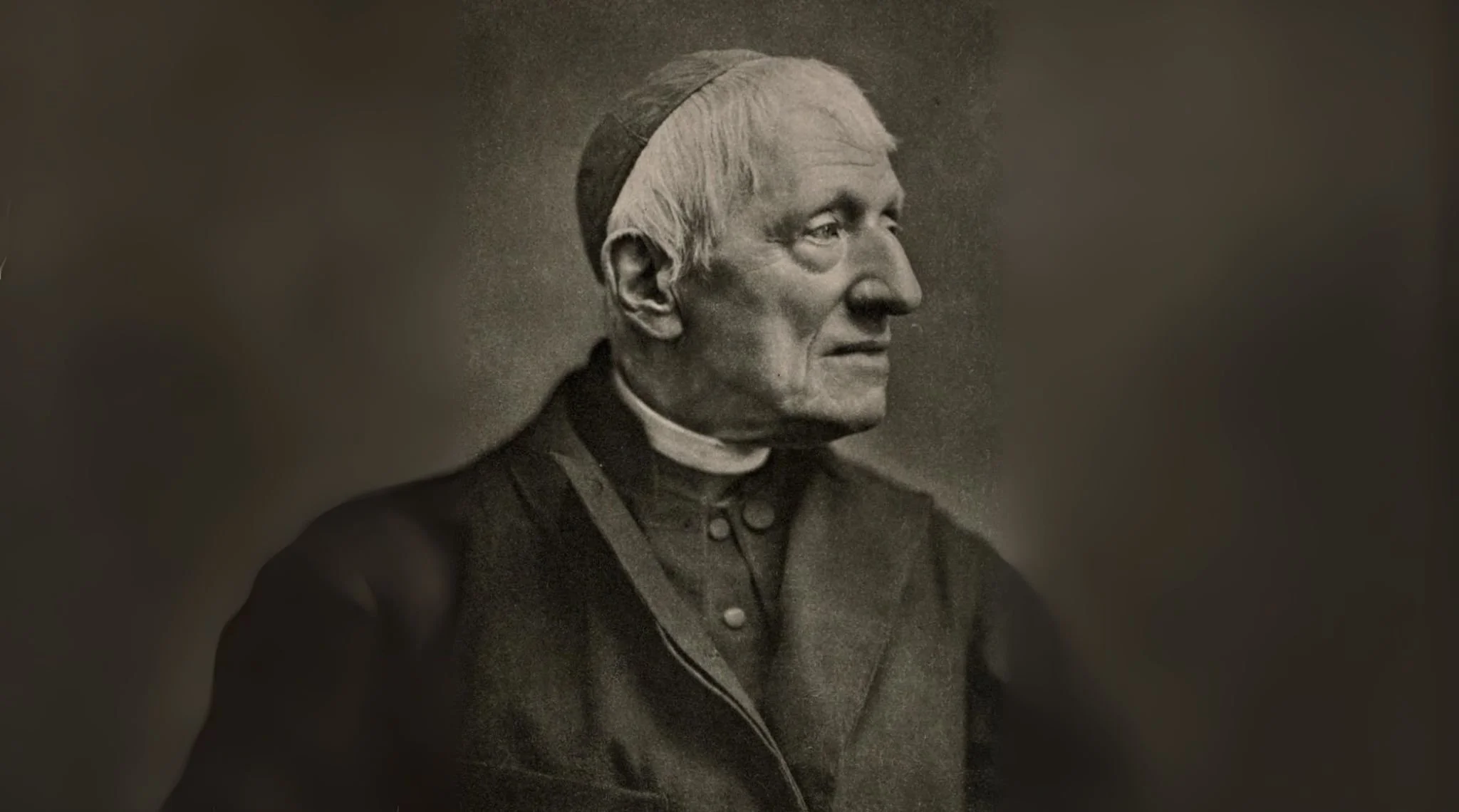
Photo of Saint John Henry Newman by Herbert Rose Barraud
He was a talented man. A scholar on the verge of obtaining a prestigious position at Oxford University as an Anglican chaplain.
But his research and writing had led him to the conviction that the Lord wants him to become Catholic.
In the 1800s, Anglicanism was the established religion of the United Kingdom.
Catholicism was barely legal and tolerated.
A loss of professional prestige, potential unemployment, and maybe even an uncertain welcome as he is received into the Church awaited.
So much uncertainty.
But he knew that one thing for certain that he needed to do.
Become Catholic.
And so he took the first step.
And composed that beautiful song which captured that moment.
Lead, kindly Light, amid the' encircling gloom;
O lead me on!
The night is dark, and I am far from home;
O lead me on!
Keep firm my feet; I do not ask to see
The distant scene, one step enough for me.[2]
A great light to remind us of who we are and to begin the path of repentance.
A kindly light so that it can enkindle in us the desire to serve the kingdom.
And enough light not to know the entire picture, but to take the next step.
And that light is Jesus Christ. The one who called Paul “not to baptise, but to preach the Good News,” (1 Cor 1:17)
And who is calling us today.
One step enough — because the One who calls is faithful.
[1] https://www.discerninghearts.com/catholic-podcasts/christian-remember-dignity-pope-st-leo-great-office-readings-2/
[2] https://hymnary.org/text/lead_kindly_light_amid_the_encircling_gl